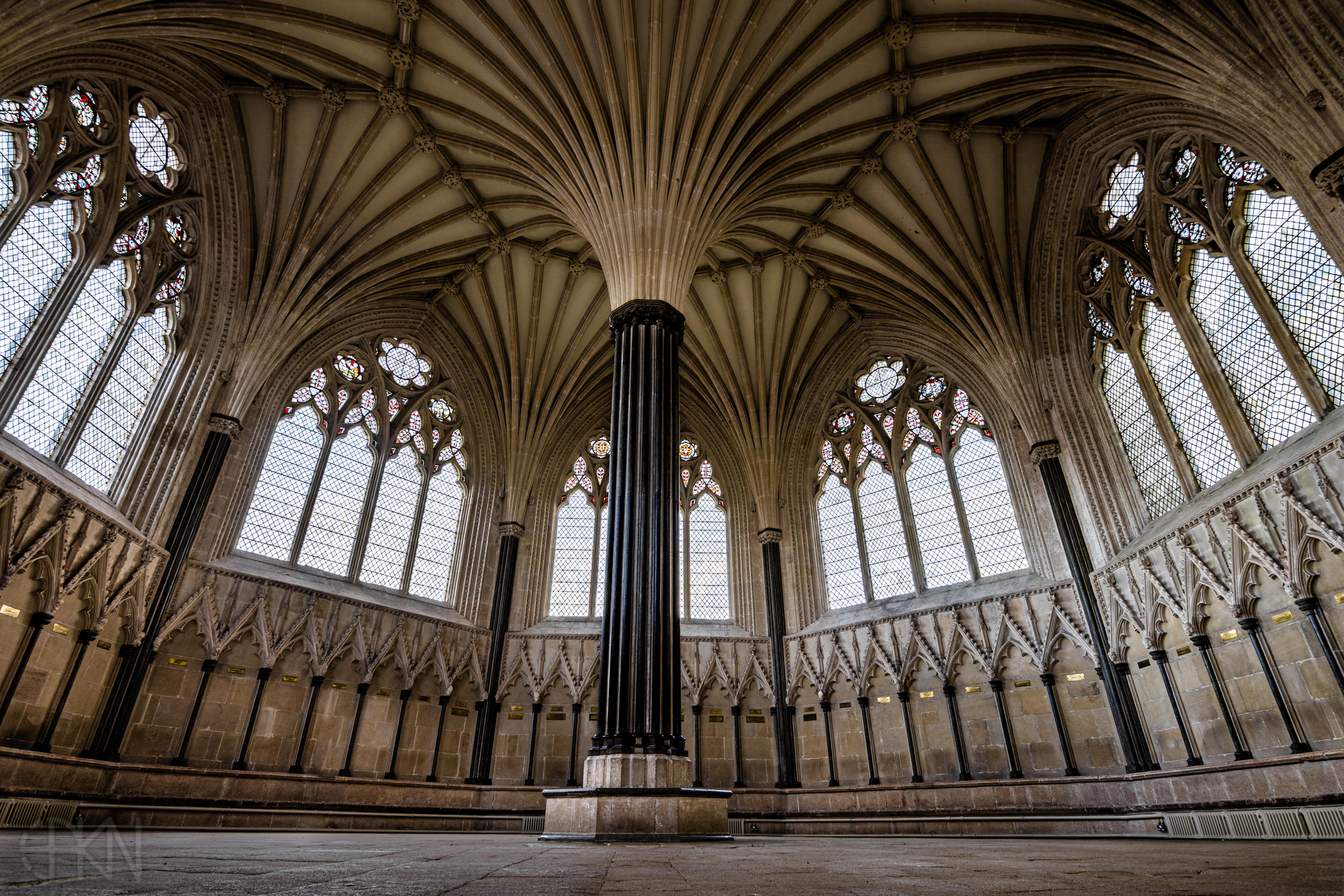
A chapter house is a building or room in a cathedral, monastery or collegiate church, intended as a place where church authorities meet in order to discuss ecclesiastical affairs or to supervise legal proceedings. The chapter house at the north-east part of Wells cathedral church is a particularly fine example, in the geometric style of decorated Gothic architecture.
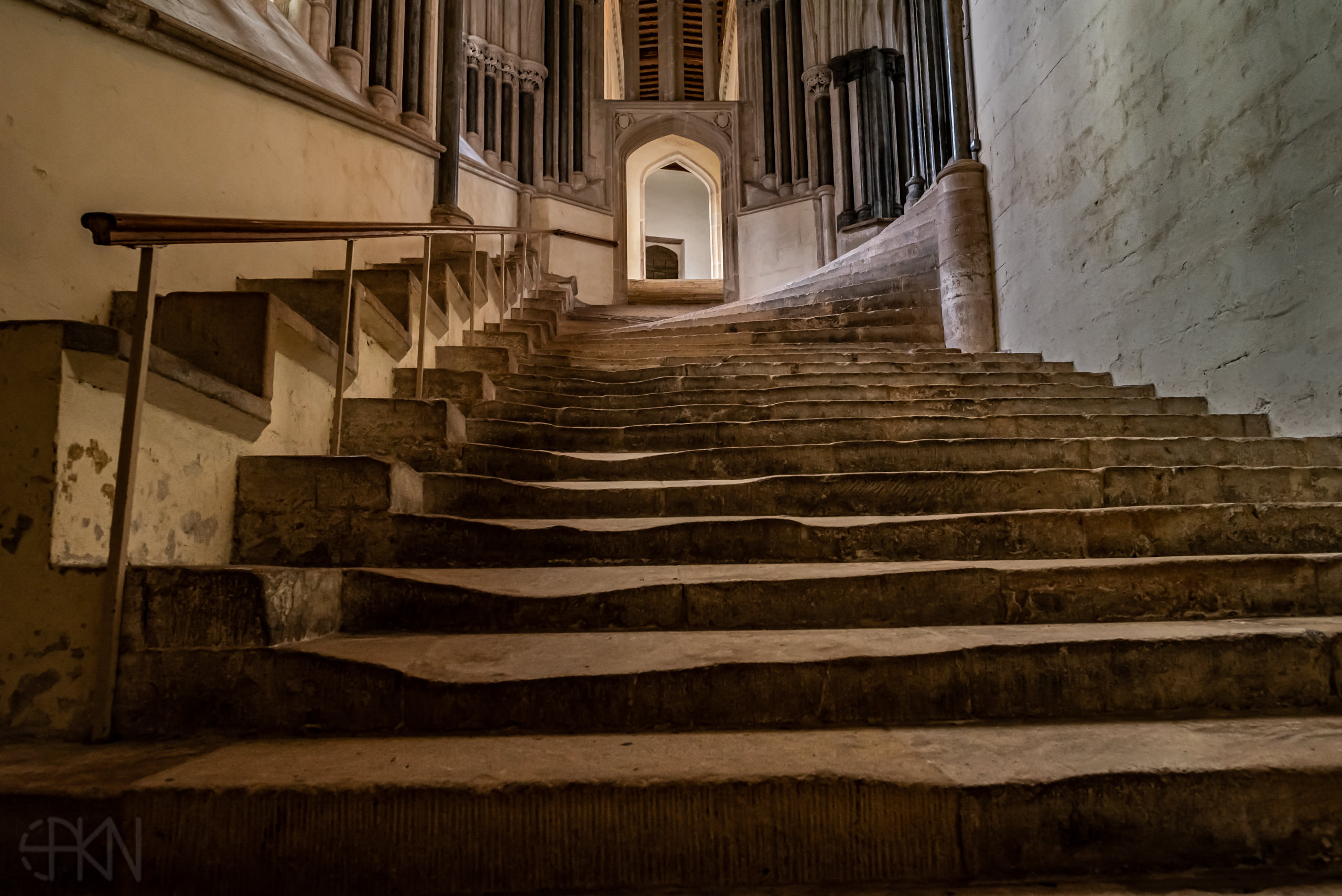
It is entered from the north choir aisle by a passage and a staircase. The steps that lead up to the chapter house (and, through the upper storey of Chain Gate, also to the Vicars Close) are visibly worn by centuries of footfall.
On the right of the steps can be seen the carving of a dragon-slaying monk. Two windows above the steps on the west side contain some of the oldest stained glass in the cathedral, dating from around 1290 (below).
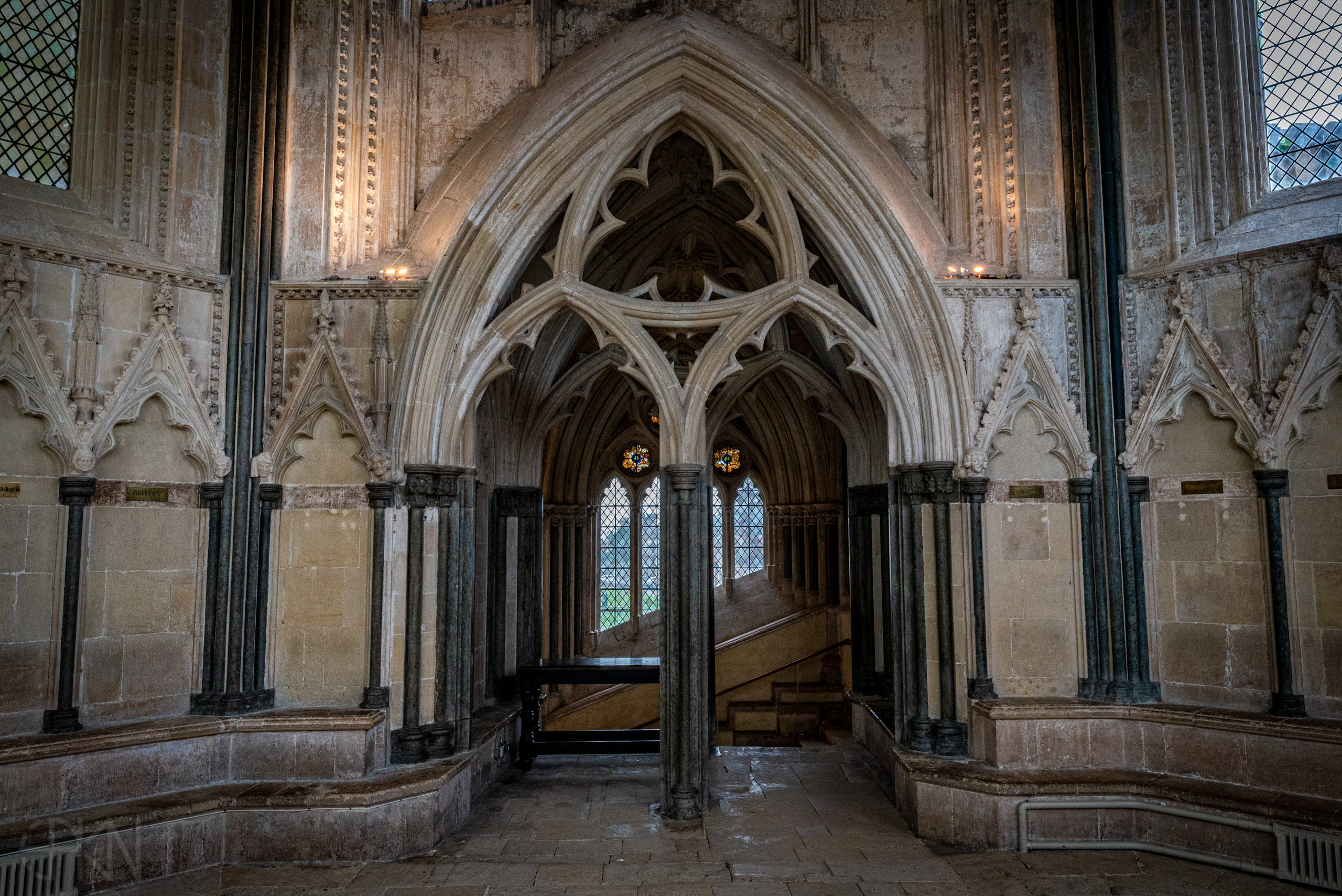
Built between 1275 and 1310 by unknown architects, the chapter house at Wells is the only one of its kind to be built as a first storey, being on top of the undercroft below.
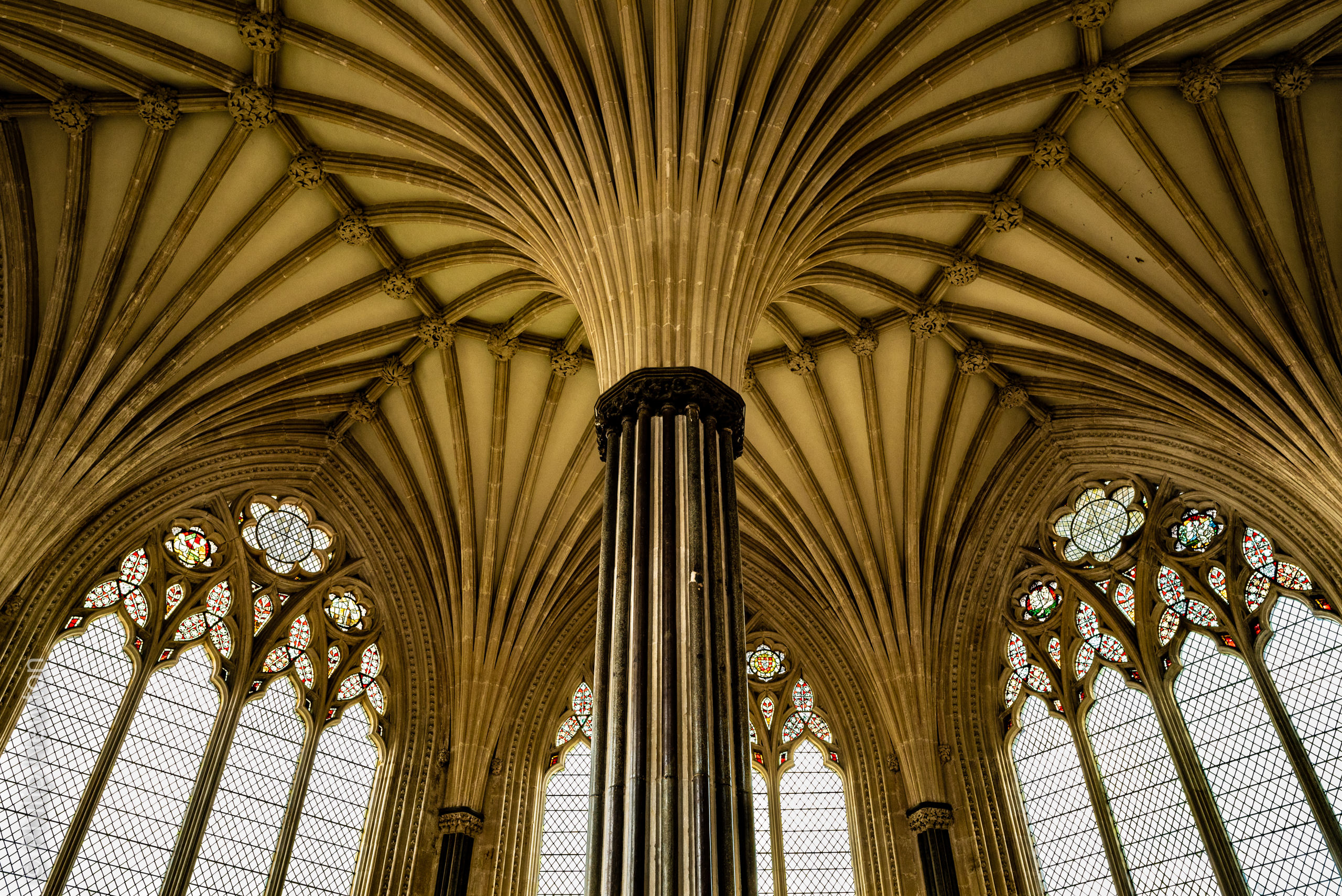
It is octagonal in shape and has a fine ribbed-vaulted ceiling. The ceiling is supported by a central column enclosed by shafts of Purbeck marble, rising to a single continuous rippling foliate capital of stylised oak leaves and acorns. Above the column rises 32 ‘lierne’ ribs that give the structure a palm tree-like appearance.
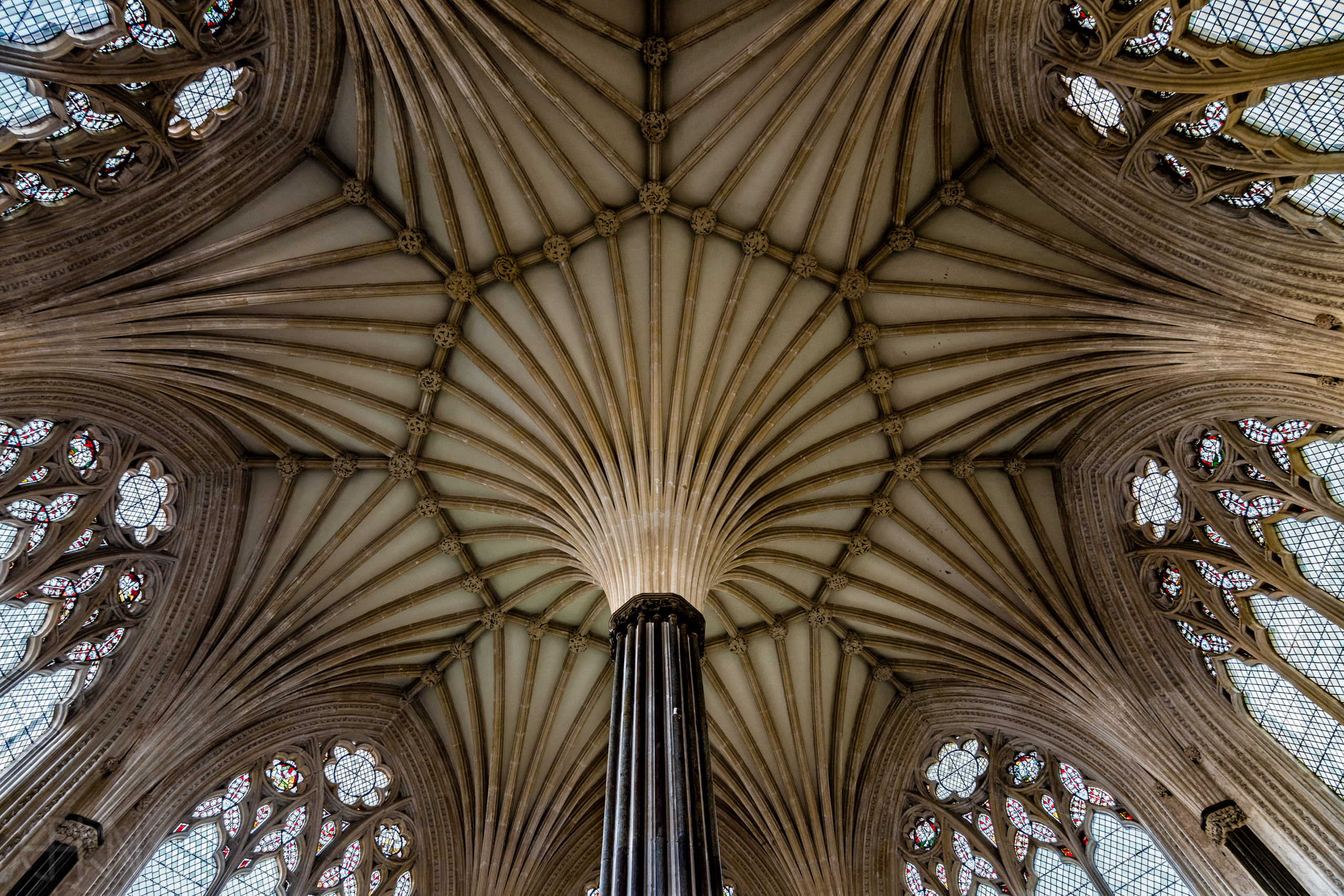
The chapter house interior has been described as “architecturally the most beautiful in England”.
Beneath the large windows of the chapter house, along its perimeter wall, are fifty-one seats or stalls for named dignitaries. Above these are inlaid canopies surmounted by carved heads, often with unusually pleasant expressions. There are also seats by the entrance steps to accommodate witnesses waiting to give their testimony.
Photography note: in order to capture that last photo of the vaulted ceiling, I found it necessary to sprawl on the floor. In that supine position, with my head at floor level, I was so engrossed in adjusting the camera settings for the picture, that for a time I must have appeared motionless. Imagine my surprise when one of the staff of the church appeared, having been told that someone had “collapsed on the floor of the Chapter house”. On reassuring the gentleman that I was perfectly all right, we admired the ceiling.
Update: In response to the comment below, here are a few photos of the carved heads that appear by each of the stalls or seats. I hope to make a separate post for these in due course. I’m not sure I see any “family similarities” though there are perhaps not enough here to make a comparison. However, it has been said that the first carving represents a female face.


On a women’s singing get together this week three of us found this magical place by accident while visiting the cathedral. There was nobody else about so we tried a little harmony singing and discovered the most staggeringly beautiful acoustics. We had goose pimples. A moment none of us will ever forget.
Has anyone noticed that the carved heads are more like portraits and in some cases, family similarities can be seen?
I live near Wells and am a frequent visitor to the cathedral. I have seen much around the world but can’t think of any room that matches the beauty and architectural splendour of the Chapter House.
The 10 sided chapter house in Lincoln and the octagonal in York with no central column are also stunning.
Do you know which six popes are represented in the carvings around the Chapter House?
I am still of the opinion that the heads are portraits or at the very least, based on portraits. Imagine yourself given the task of carving a number of heads.You need a basis for doing this and there is a limit to the number of different features you can invent. In the position of a carver or carvers, charged with the task I would certainly use the faces of people I am familiar with ( I am a sculptor long ago retired) for material , inspiration if you like, and what a good opportunity for recording the identity of your fellow workers. It is worth the imaginative effort it takes to put yourself in the shoes of the people involved in the construction; they were people like us.
I think the use of AI could now resolve this
Why does the list of films made in Wells cathedral make no reference to Pasolini’s Racconti di Canterbury, The Canterbury Tales ?